
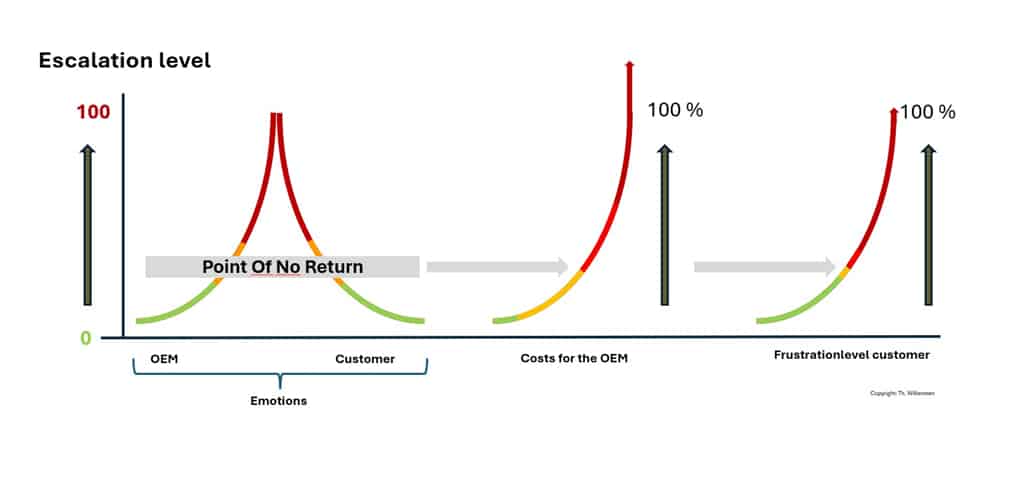
The “Point of No Return” in After Sales
Why many companies recognize it too late – and what it really costs
Anyone working in After Sales or close to the customer knows this situation well: A customer calls because something has gone wrong and urgent support is needed. The typical initial reaction in many organizations- especially outside the After Sales function- is predictable: “The customer is at fault.”
This reaction serves two purposes at the same time: It protects the company – and it avoids work. Because taking a customer issue seriously means investigating, asking questions, checking data, involving interfaces and departments.
In short: working like Sherlock Holmes and putting one’s own current tasks on hold. Yet the most important question is often not asked at all: Why is the customer calling in the first place?
In times of limited resources, customers do not complain without reason. There is almost
always a real issue behind the call.
How the “Point of No Return” develops
If clarification is delayed or responsibility is pushed back to the customer without solid evidence, frustration on the customer side grows. Eventually, a point is reached where neither party can step back without losing face.
Positions harden.
Too much time has been spent defending one’s own standpoint.
Admitting a mistake now feels impossible.
Supplier and customer become stuck – each unwilling to acknowledge any contribution to the problem.
This is the moment when it happens: The Point of No Return
The point at which costs and emotions escalate dramatically for everyone involved.
What happens after the point is reached?
- Endless discussions
- Internal and external blame games
- Lost time through visits, meetings, and escalations
- Rapidly rising internal costs
- In the end, the supplier often gives in anyway to preserve the customer relationship
The result is sobering: The customer remembers the long and exhausting struggle.
The supplier remembers the massive internal effort. And both sides lose.
What 25+ years of After Sales experience have shown me
The most expensive solution is almost always the late solution. In contrast, the most effective and economically sound strategy is usually this: Find a fast and fair solution – independent of the question of fault.
If it later turns out that the customer was indeed responsible, customers are generally willing to pay for the solution that was provided.
In around 90% of cases, customers accept a pragmatic and especially a fast solution – even with a 50:50 cost split – if they feel one thing clearly: “The supplier is taking my problem seriously and acting immediately.”
The tangible benefits of early action
- Customers retain a positive experience
- Internal costs for the OEM remain predictable
- Customer relationships are strengthened rather than damaged
- Internal resources stay focused on value-adding activities and new business
Personal conclusion
The “Point of No Return” is not a theoretical concept.
It is real, it is expensive, and in many cases it is avoidable.
Fast and fair solutions are not a sign of weakness.
They are the economically smarter choice.
The earlier action is taken, the lower the cost – for everyone involved.


