
Pricing in After Sales for the Machinery Industry – Challenges, Trends, and ProvenPaths to Success
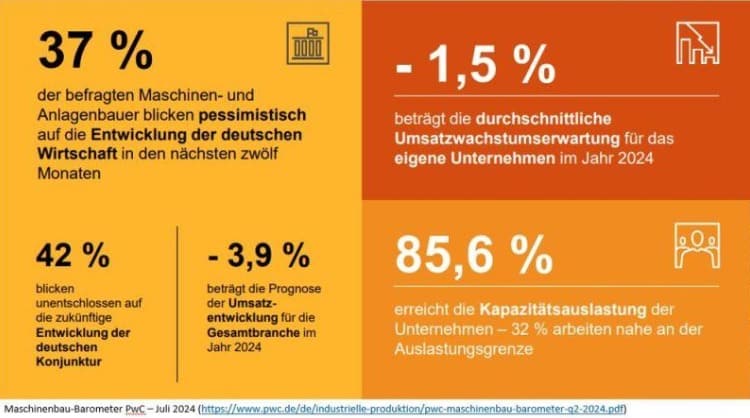
In recent years, I have supported numerous mechanical engineering companies – often during phases of declining order ntake and growing market uncertainty. This picture is also reflected in the current PwC Machinery Industry Barometer: the industry is facing a persistently challenging market environment that is already having a noticeable impact on many companies.
While revenues in the new machinery business are stagnating or declining, after-sales revenues are also beginning to decrease with a certain time lag. One key reason is the lower utilization of machines at end customers, which reduces demand for spare parts and services. However, this is only one aspect of a far more complex market environment.
Market Changes That Are Reshaping the Spare Parts Business
In many discussions, I observe that companies underestimate their actual competitive situation in the spare parts business. Competitors that were barely noticed for years have steadily gained market share – often quietly and unnoticed. Particularly in the spare parts business, the following applies today:
Competition is more visible, more digital, and faster than ever before.
Why is this the case?
- End customers make far greater use of the internet to compare prices and
identify alternative suppliers. - Spare parts marketplaces and online retailers have fundamentally changed the
competitive landscape. - Price structures have become transparent, meaning weaknesses in pricing are
exposed much more quickly than in the past.
For this reason, spare parts pricing has become a decisive competitive advantage – or disadvantage.
Many OEMs still rely on a traditional cost-plus approach. While this model may appear simple, it rarely meets today’s market requirements. What worked in the past is no longer sufficien.
What Matters in Spare Parts Pricing Today
Based on my experience, OEMs must approach pricing in a far more differentiated way. The following factors play a central role – and their relevance varies depending on region, market, and customer structure:
1. Competitive Environment
- How active are independent suppliers in this region?
- What price levels are they offering?
- What delivery times and service levels do alternative providers offer?
2. Sales Frequency
- Frequently sold parts require a different pricing approach than rare or highly specialized components.
3. Customer Relevance
- Critical components have a higher perceived value than parts that do not impact machine availability.
4. Purchased vs. In-House Manufactured Parts
- In-house manufacturing allows for different pricing levers than pure trading goods.
5. Unique Selling Propositions (USP)
- When does the customer clearly recognize added value?
- How high is the perceived benefit compared to alternative parts?
6. Margin Contribution by Product Group
- Some product groups contribute disproportionately to profitability, while others dilute results.
7. Global Purchasing Prices
- Can the same item be sourced significantly cheaper in certain regions?
- Are there local suppliers that can support a more optimized pricing strategy?
These factors clearly show that there is no one-size-fits-all solution.
What works in Germany may fail in Asia or Latin America – and vice versa.
Why Regional Differentiation Is Essential
Many companies attempt to enforce globally uniform spare parts pricing. In practice, this often leads to problems:
- In some markets, prices are too high, prompting customers to switch to alternative suppliers.
- In other markets, prices are too low, resulting in missed margin potential.
Differentiated regional pricing is complex – but essential.
Practical Examples from Recent Years
The work of recent years – often in the form of interim mandates – has demonstrated just how significant the potential is when pricing is managed intelligently. Two examples:
1. Higher Contribution Margin Without Loss of Revenue
Through targeted price increases in selected areas, contribution margins were improved by up to 10% – without any negative impact on sales volumes. The market accepted the prices because they were well-justified and implemented in a ifferentiated manner.
2. Revenue Growth Through Selective Price Reductions
In another case, a combination of price reductions and an optimized sourcing strategy led to revenue increases of up to 20% for certain items.
The key levers here were:
- improved market fit,
- regional differentiation,
- and lower procurement costs.
These examples clearly illustrate that pricing is not a rigid system, but a strategic instrument that significantly influences both revenue and profitability.
Conclusion: Pricing Determines Success in After Sales
After sales will become even more important for many machinery manufacturers in the future. Those who want to secure or regain market share cannot avoid professional, data-driven, and regionally differentiated pricing.
Modern spare parts pricing:
- strengthens competitiveness,
- increases margins,
- protects the spare parts business against third-party suppliers,
- and enhances customer satisfaction by making prices more transparent and fair.
And in the end, one thing becomes clear time and again:
It is not the cheapest supplier that wins – but the one who truly understands pricing and manages it strategically.


